

Skybeard is here: the first realmaker game
What started as a feasibility study is now a finished game on the App Store and Google Play: Skybeard, the first realmaker game. An old inventor, eleven flying machines and a single finger – and, for me, the pinnacle of media design.
 7 min read
 AI-generated
Contents
The pinnacle of media design
I’m very proud of the first realmaker game. To me, game design has always been something like the pinnacle of media design: the player feels every tiny decision, every feature, every design and the overall concept right away. You have to deliver on every level – visually, technically, audiovisually. In the end, you create an experience with just one job: to entertain the player.
From sketch to store
It all started six years ago with a sketch: my wife drew the Professor for the very first time. Step by step, it grew into the idea of a one-finger flying game, many prototypes, mechanics of its own for every machine and long phases of testing and tuning.
What started as a feasibility study actually ended up in the stores as a finished game: on the App Store for iPhone and iPad since October 15, and on Google Play for Android since October 17. I’ve been developing apps for Apple platforms since 2011 – and still I’ve gained a lot of experience and learned a great deal about game development, engines, the stores and publishing. That benefits my client projects, too; more on that under Desktop software & apps.
The story trailer
Professor Skybeard dreams of the Grande Finale: one flight with all eleven machines he has built. Someone else has to fly them, though. The story trailer shows the journey there.
One finger, eleven flying machines
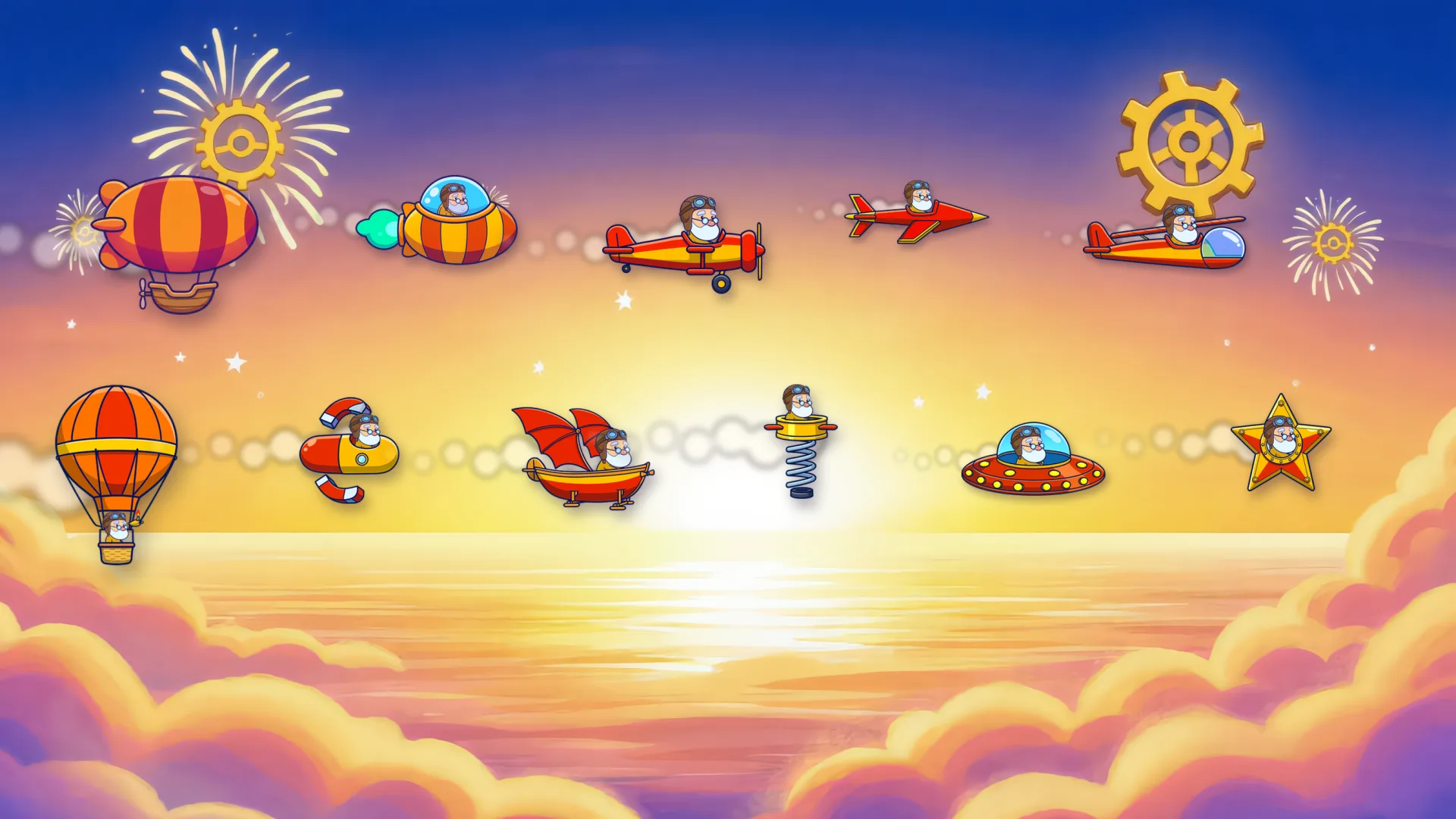
Professor Skybeard is an old inventor with a long white beard and an aviator cap. He builds the flying machines, you fly them as his test pilot. You fly every machine with just one finger, but each one completely differently. You’ve barely got the hang of one before you have to get a feel for the next:
- Zeppelin: hold to climb – sluggish, the lift only turns around slowly.
- Spaceship: hold for upward thrust.
- Biplane: hold to raise the nose, but climbing costs speed.
- Dart Glider: hold to angle upward, with no inertia at all.
- Sailplane: the other way round – hold to dive, only momentum carries it.
- Magnet Capsule: your finger above the capsule pulls it up; the distance sets the force.
- Ornithopter: every tap is a wingbeat, so pace your stamina.
- Pogo Spring: hold to wind the spring, release to jump.
- UFO: tap to flip gravity.
- Star: tap at the top to go up, at the bottom to go down.
- Balloon: tap to fire the burner – it kicks in with a delay.
Five worlds and the Grande Finale
The journey leads through five worlds with ten levels each, and every world brings its own mechanics:
- Hill Country: the start, ending with the climb above the clouds to the summit.
- Coast: gusts with an early warning, rock formations and caves with an underwater treasure grotto.
- Desert: heat fields with thermals, sandstorms and camels.
- Night Sky: darkness, beacons that light the way, and shooting stars.
- Thunderstorm: lightning in rhythm, tailwind and electric shocks that swap up and down. Right in the middle of it: Benji, the Professor’s dog with the blue scarf.
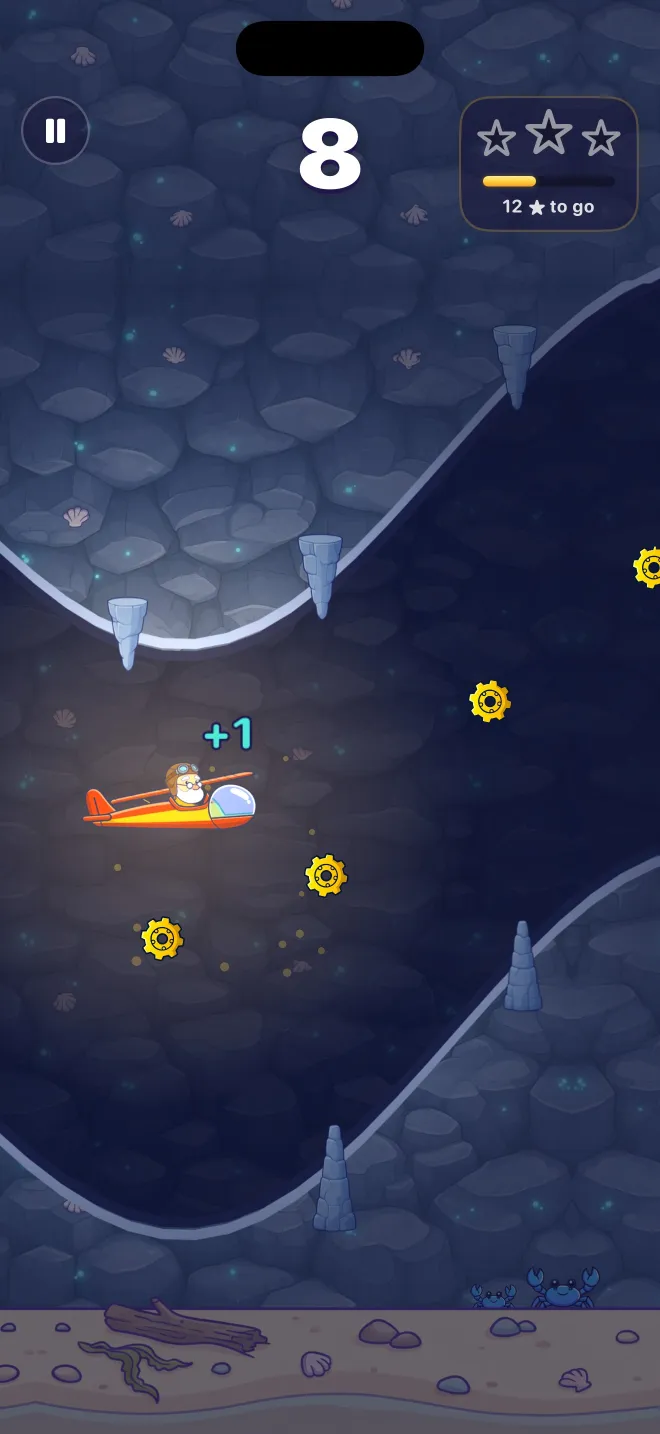
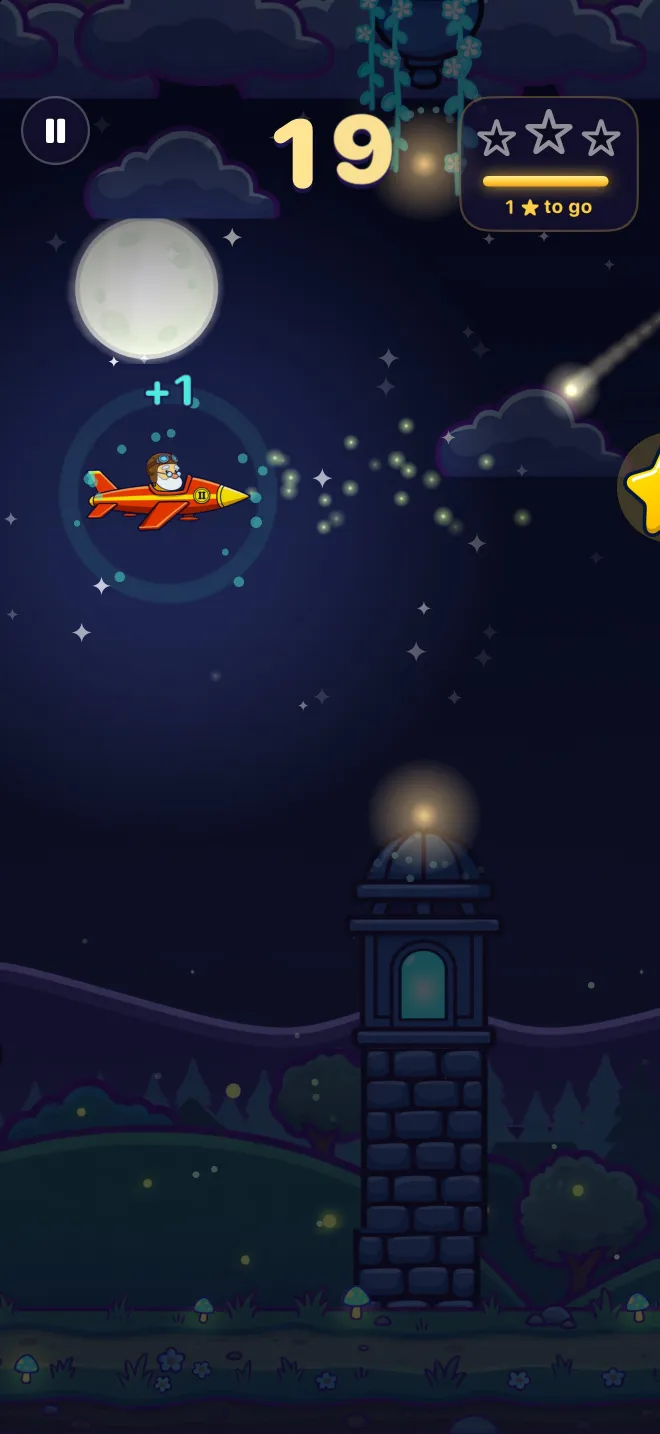
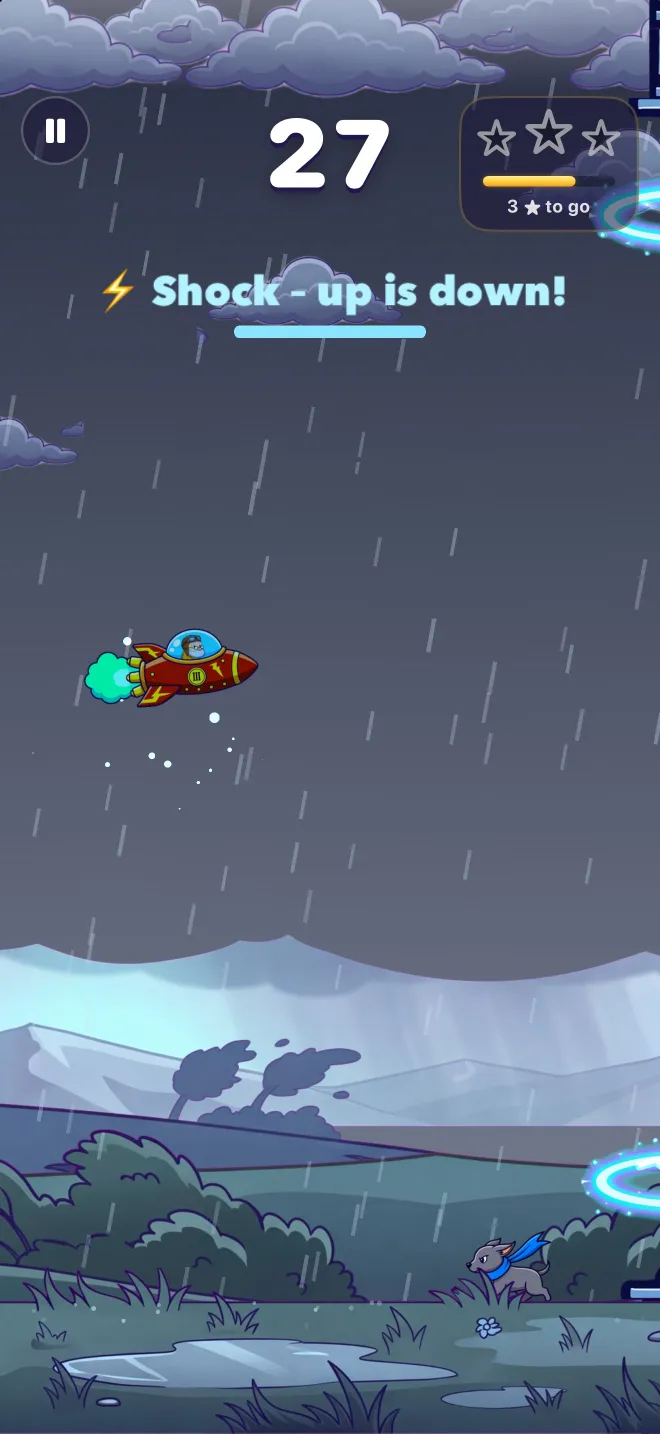
At the end, the Grande Finale awaits: all eleven machines one after another, 99 gates, right across all the worlds. Every level has three rounds – from Explore with checkpoints through the Trial to the Master Flight without a safety net – and five stars, including a secret star for the brave.
With the gears you earn by flying, you build new machines in the workshop, paint them in chrome and gold and dress up the Professor: eight beards, nine hats, eight flight trails. On top of that there’s a flight school with 33 lessons, an endless mode and a bonus party for every world, and the Professor’s diary: 24 pages of his thoughts on his machines, with a wink.
Hard, but fair
Skybeard isn’t easy, and that’s on purpose. It stays fair all the same: a computer pilot flew every level with room to spare before it made it into the game. And so did I, of course – so many times that by the end my own game was almost no fun anymore. After a crash you’re back in the air instantly, with no waiting. And you can’t get stuck: the next level opens with just one star, and after five failed attempts you may skip a level.
The game logic is my own development and computes bit-for-bit identically on iOS and Android: the same inputs produce the same flight.
Made for big screens
Skybeard is a portrait game, but on big screens it doesn’t just get stretched. On iPad in landscape, on Android tablets and on unfolded foldables, the screen becomes the inventor’s book: the game runs on one page, the Professor’s handwritten notebook lies on the other. The Professor flies along as a pasted-in photo, cheers at every star and stands there covered in soot after a crash.
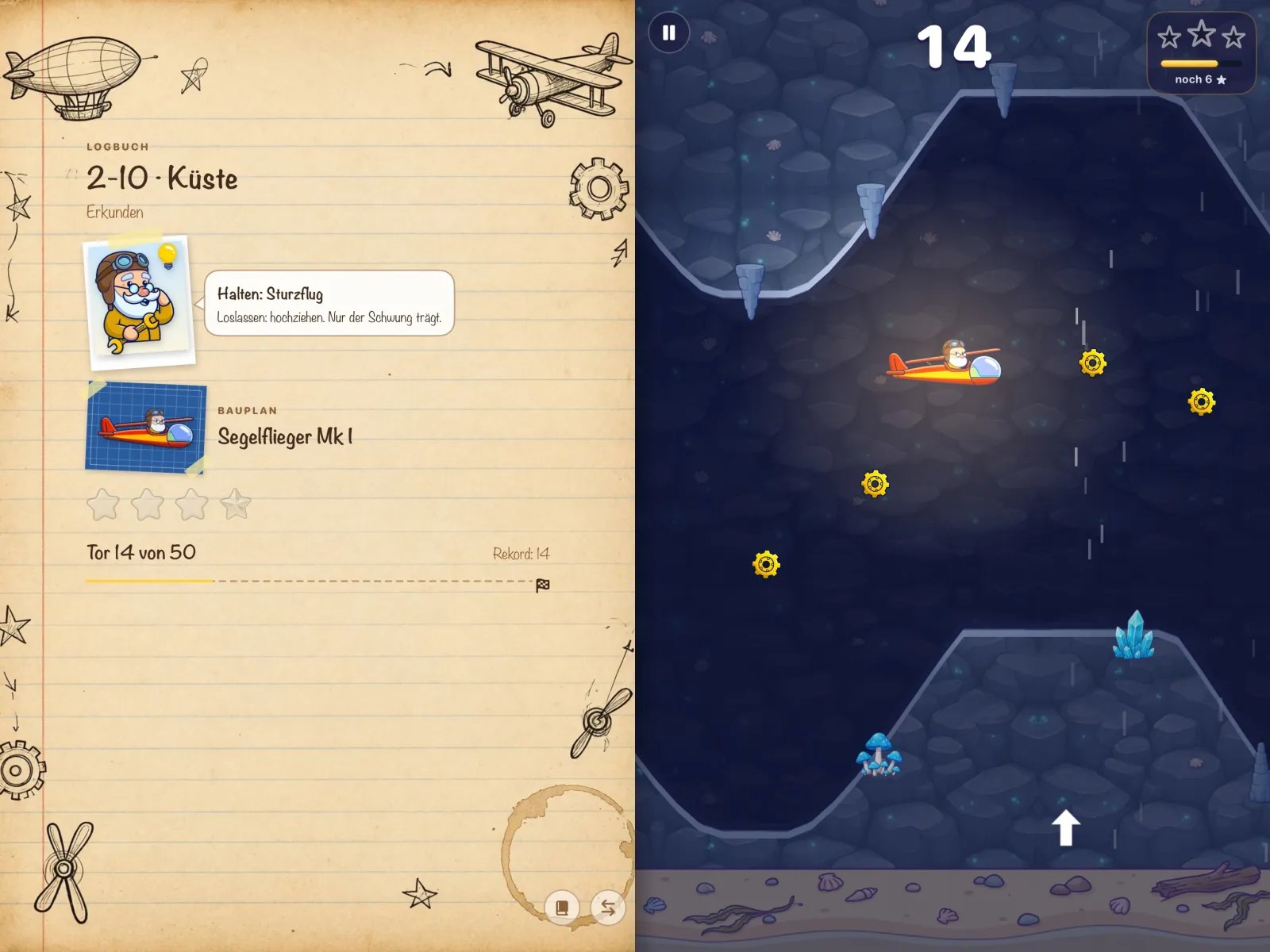
Half-folded, a foldable becomes the console: the game on top, a control desk below, like on a handheld console. That way your finger never covers the machine again. On iPhone Duo, both views are ready from its launch on October 23.
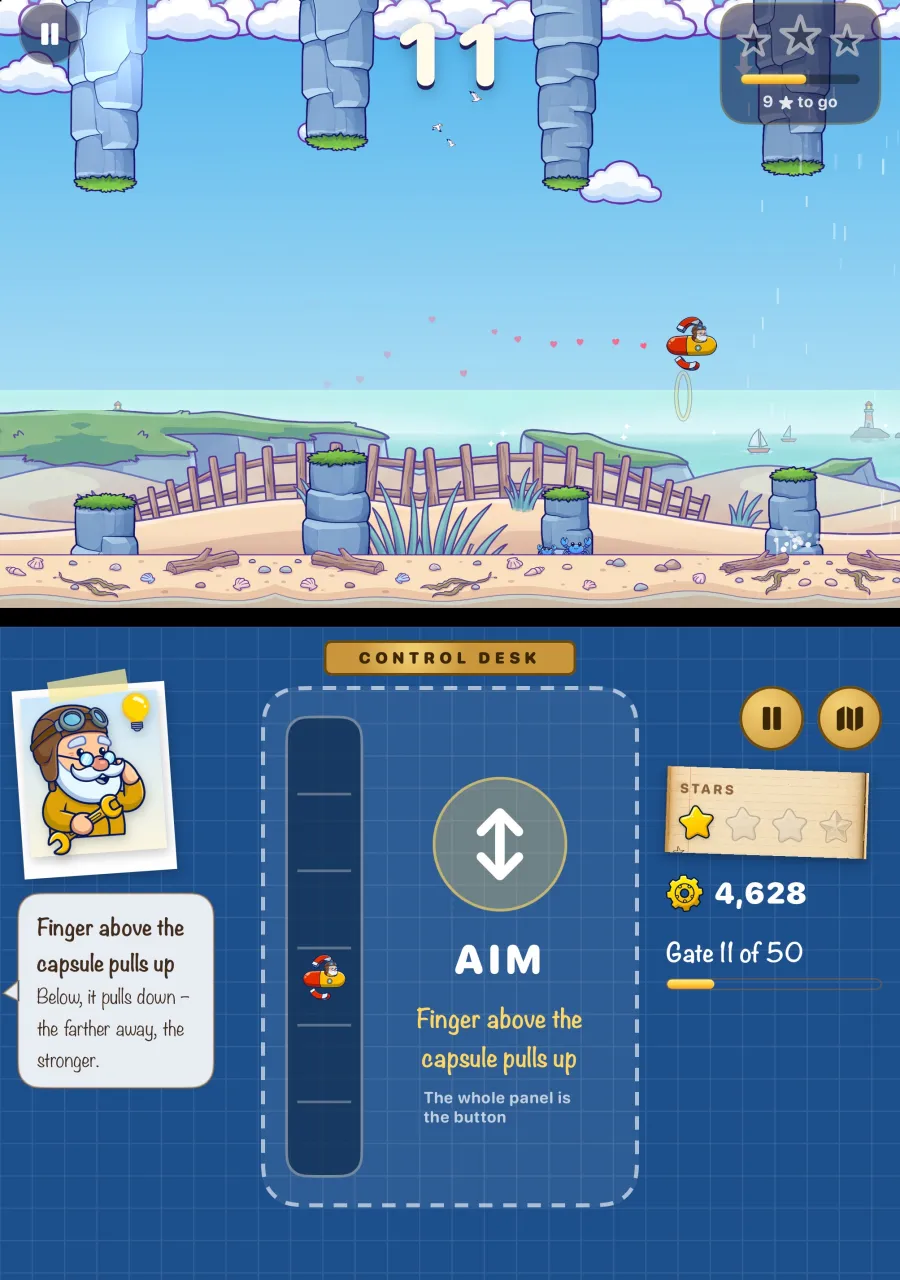
The iPhone Duo came along when the game was actually already finished. I decided to optimize Skybeard for it anyway, which meant getting to grips with every screen option the new iPhone has: the outer screen and the inner screen – portrait, landscape and folded. For developers in particular, it’s a very special device: the screen formats are completely new, and they open up some genuinely interesting concepts. In the end the iPad benefited too, where Skybeard had only run in portrait until then, because the inventor’s book arrived with the Duo. In a second step I made it possible to turn the book off. That makes the levels playable in landscape across the full width as well – on iPad with or without the book, and on the Duo too, of course.
At first I very nearly forgot about the folded mode, yet it calls for an entirely different way of playing. Half-folded, the Duo is a little reminiscent of the Nintendo DS. For this I built the control desk, which adapts to how each individual flying machine is controlled. You no longer steer on the game image itself but on the screen below – depending on the machine, by pressing or with a kind of position slider. Moving the controls to a “different” screen really does create a whole new feel for the game.
Free, without pressure
Skybeard is free, and everything in the game can be reached without buying anything. Ads only appear between levels – at most every three levels and never in the first five minutes. If you don’t want them, a one-time purchase turns them off. There are also a few small packs, with no subscription and no loot boxes. You don’t need an account: your progress stays on your device.
Play now
Map 1 is only the beginning – a second map is already in the works. Until then, I invite everyone to play a few levels of Skybeard – free, in twelve languages, for iPhone, iPad and Android. You’ll find everything else about the game on games.realmaker.de.


Frequently asked questions about Skybeard
Is Skybeard available for Android?
Yes. Since October 17, 2026, Skybeard has been on Google Play for phones, tablets and foldables running Android 8 or later. For iPhone and iPad, Skybeard has been on the App Store since October 15, for iOS 17 or later.
How much does Skybeard cost?
Nothing. Skybeard is free, and everything can be reached without buying anything. Ads only run between levels and can be turned off with a one-time purchase of €5.99.
Is Skybeard too hard?
Hard, yes – unfair, no: a computer pilot cleared every level before it made it into the game. After five failed attempts you may skip a level.
Which languages is Skybeard available in?
Twelve: English, German, French, Spanish, Italian, Portuguese (Brazil), Japanese, Korean, Chinese (Simplified and Traditional), Russian and Turkish.
What age is Skybeard suitable for?
Skybeard is rated for all ages: USK 0, PEGI 3 and 4+ on the App Store.
Michael Rademacher
Founder of realmaker
Michael Rademacher founded realmaker in 2003. He develops WordPress websites and software, produces films and live streams, and writes here about what he learns in client projects.
About Michael
Got a product idea?
Tell me about it. In a free initial call – 30 minutes by video or phone – we clarify the goal, the scope and the most sensible way forward.